
1. Introduction
Remember when “just Google it” was the standard way to find information online? The process was simple: enter a search term, review the results, and click the links that seemed most useful.
Today, searching for information is about more than finding website links. People increasingly want direct answers, explanations, comparisons, and practical solutions.
The growing use of AI tools and AI-powered features in search has sparked an important question: ChatGPT vs. Google Search—which one should you use?
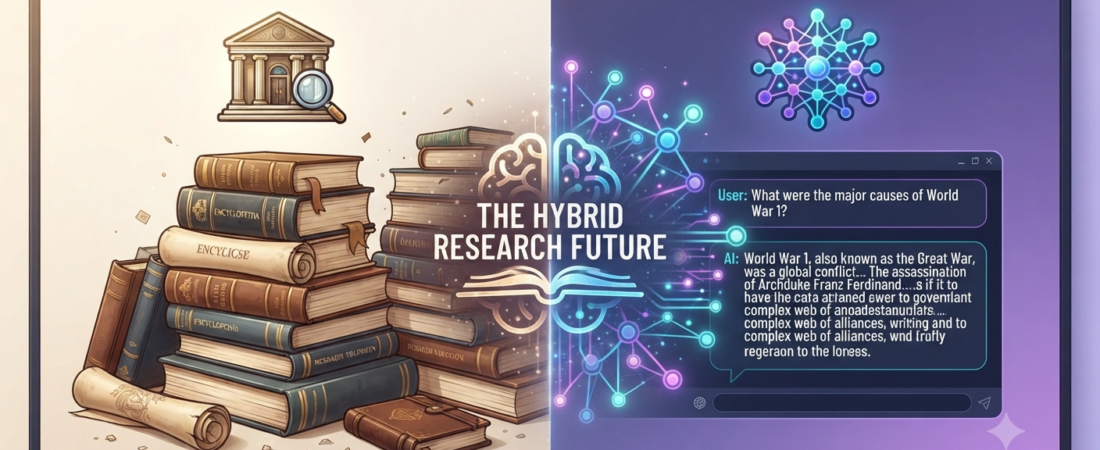
The real question is not which one is “winning.” If you want to research effectively, you do not have to choose one over the other. Instead, it is important to understand when each tool is most useful.
2. How They Work: The Technical Breakdown
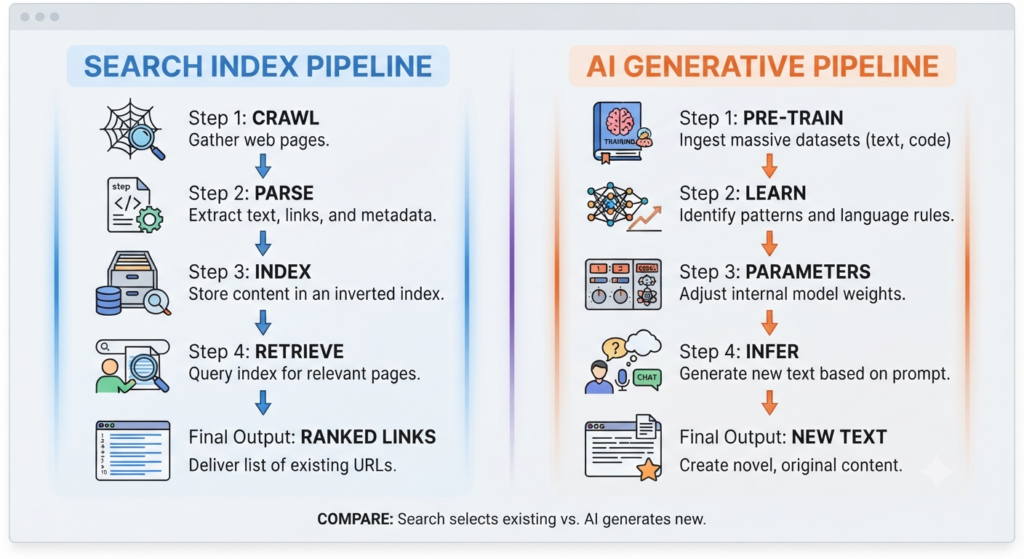
Understanding the Difference Between Retrieval and Generation
Understanding how these tools work can help you choose the right one for different research tasks.
- Google Search is similar to a librarian: it helps organize and surface relevant web pages, documents, videos, and other sources. Rather than creating a single answer from scratch, it helps you discover information from across the web.
- ChatGPT is more like an assistant that generates a conversational response based on the information available to it. Generative AI can also create new content based on patterns learned during training.
Both tools continue to evolve, but they serve different purposes.
3. Head-to-Head: ChatGPT vs. Google Search
To help you decide, let’s look at how these platforms compare across the most important search categories:
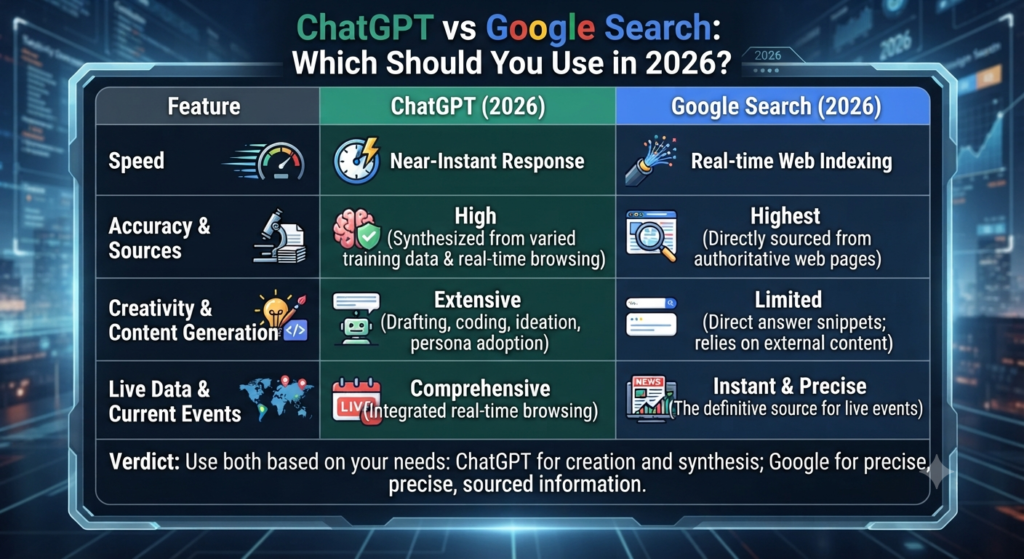
| Feature | Google Search | ChatGPT |
| Primary Goal | Finding the best, most reliable source | Providing immediate, summarized answers |
| Accuracy | Depends on the sources and search results | Variable (can occasionally “hallucinate”) |
| Real-Time Data | Useful for current web information | Useful when current web access is available |
| User Experience | List-based (browse, compare, & explore) | Conversational (back-and-forth dialogue) |
| Best For | Finding sources, comparing information, shopping, local searches | Explaining, brainstorming, summarizing, and synthesizing |
4. When to Use Which: Your 2026 Cheat Sheet
Using the right tool for the task can save time. Here is a quick guide to choosing the best option for different types of searches:
1. Use Google Search when:
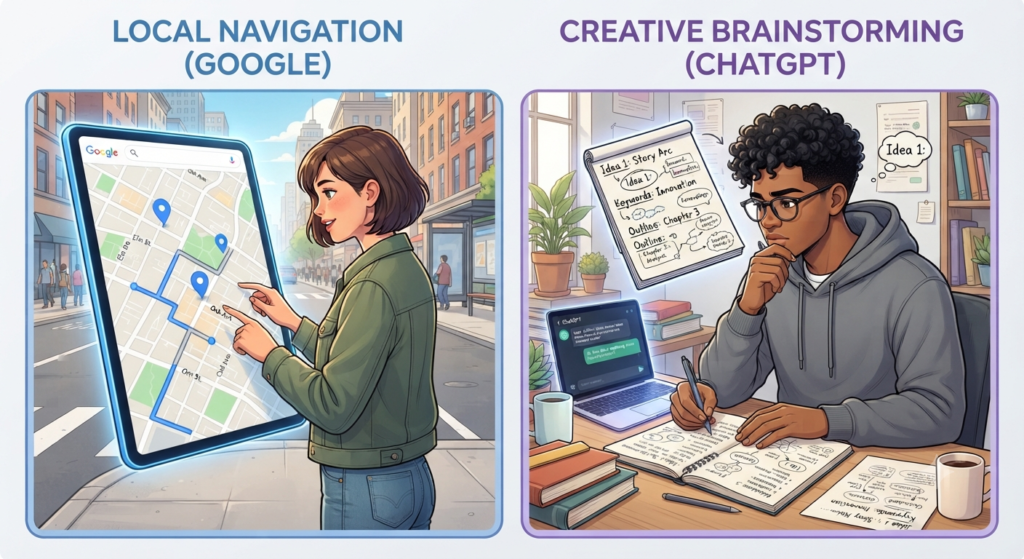
- You need to navigate somewhere: If you are looking for a specific website, service, login page, or pricing page, a search engine can help you locate the relevant page quickly.
- You need local information: When you want to find nearby businesses, menus, locations, opening hours, or prices, search engines and map services can help you explore current local information.
- You want multiple perspectives: For complex or subjective topics, searching across different websites, news sources, and discussions can help you compare viewpoints instead of relying on a single summary.
2. Use ChatGPT when:
- You are learning a concept: If you search for “How does a neural network work?”, you may find several articles to read. With ChatGPT, you can instead ask for a simple explanation and follow up with questions until the concept becomes clearer.
- You need to create something: If you are dealing with writer’s block, drafting an email, or brainstorming ideas for a marketing campaign, ChatGPT can act as a creative assistant rather than simply a search tool.
- You need to synthesize information: If you have a long report and want to identify its three most important risks, ChatGPT can help summarize and organize the information quickly. You should still review the original document when accuracy matters. AI can sometimes produce convincing but inaccurate information, so it is important to avoid common AI mistakes and verify important claims.
5. Future of Search
Is ChatGPT Replacing Google? Understanding the Future of Hybrid Search
There has been considerable discussion about whether AI assistants could replace traditional search. At the same time, search engines are also incorporating AI-powered features into the search experience.
The answer is more nuanced than a simple yes or no. Rather than one tool necessarily replacing the other, search is moving toward a more integrated experience in which AI assistants and traditional search can complement each other. Search engines are adding AI-powered features, while AI assistants can increasingly work with current web information when web access is available.
The important change is that effective research is less about choosing a winner and more about knowing how to use different tools appropriately. A simple two-step research process can combine AI-assisted exploration with source verification.
A practical workflow looks like this:
- AI Exploration: Start with an AI assistant to explore a topic, organize your thoughts, ask questions, or turn a vague idea into a clearer plan.
- Source Verification: Once AI provides a useful framework, use a search engine to locate relevant and authoritative sources. Check important facts against original or trustworthy sources before relying on them.
What Makes This Hybrid Approach Effective?
Think of it like a writer using different tools for different tasks. A computer does not make a pen useless; each tool serves a different purpose. The same idea applies to AI assistants and search engines.
AI can process and summarize large amounts of information quickly, helping you identify useful ideas and areas to explore further.
Search engines provide a path to the original web sources, allowing you to investigate and verify important information.
The future of search does not have to be a battle between AI and traditional search. The real skill is knowing when to use AI for exploration and synthesis and when to use search engines to find and verify sources. Used together, these tools can make research more efficient while helping you maintain accuracy.

6. The “Power Move”: Researching Like a Pro
The Power Move: A Two-Step Research Process
There is no need to choose sides. These tools can work together as part of a simple research workflow. Try the following two-step process to make your research more efficient:
1. ChatGPT — Explore: Begin by asking ChatGPT for the big picture. For example, ask, “What are the key points in this topic?” Use the response as a starting point for further research.
2. Search — Verify: Search for the important facts you learned and compare them with credible sources. Review the original sources rather than assuming that an AI-generated response is automatically correct.

7. Final Thoughts
Don’t focus on finding a winner in the ChatGPT vs. Google Search debate. Think of ChatGPT as an assistant for explaining, drafting, learning, and organizing information, while search engines help you discover websites, compare sources, and verify important facts.
Using both tools according to the task can make your research more efficient while encouraging you to verify important information before relying on it.
Which approach do you prefer for research: starting with an AI assistant, beginning with a search engine, or using both? Share your approach in the comments below.
FAQs
1. Is ChatGPT replacing Google Search?
Answer: Not necessarily. ChatGPT and Google Search serve different purposes. Search engines help you discover websites and sources, while ChatGPT can help explain, summarize, brainstorm, and synthesize information.
2. Which is more accurate for factual information?
Answer: Neither is automatically accurate in every situation. Google Search can be useful for fact-checking because it helps you locate original and authoritative sources. ChatGPT can provide clear explanations and summaries, but it can also make mistakes, so important claims should be verified.
3. Can I use ChatGPT to find real-time news?
Answer: ChatGPT can help summarize recent news when current web information is available. For breaking news and rapidly changing events, it is important to check current sources directly and compare information from reliable publishers.
4. When should I use ChatGPT instead of Google?
Answer: Use ChatGPT for complex, creative, or analytical tasks such as summarizing documents, brainstorming ideas, explaining difficult concepts, drafting content, or helping with code.
5. When is Google Search the better choice?
Answer: Search engines are especially useful for navigational searches, shopping and product research, local information, and situations where you want to compare multiple perspectives or locate primary sources.
6. Do ChatGPT and Google Search “think” the same way?
Answer: No. Search engines primarily help users discover and rank existing web content, while ChatGPT generates conversational responses based on patterns learned during training and, when available, additional information from connected tools or sources.
7. Do you prefer to use both for research?
Answer: Yes. A useful approach is to use ChatGPT for exploration, brainstorming, and synthesis, then use search engines to find credible sources and verify important facts.
8. Which is the best tool for business searches?
Answer: Search engines and map services are useful for business searches because they can help you find services, locations, reviews, opening hours, and contact information. Always check the business’s official website or profile when accuracy matters.
9. Will ChatGPT be a “lazy” way of fact-checking?
Answer: It can be. Because AI provides convenient answers, users may be tempted to skip source verification. Treat AI responses as a starting point rather than the final word, especially when the information is important or time-sensitive.
10. Are there specific prompts I should use for better results?
Answer: For search engines, use specific keywords and useful search operators when appropriate, such as “site:gov” when you want results from government websites. For ChatGPT, use context-rich prompts that include your goal, relevant details, constraints, and examples of the desired format.
11. Is ChatGPT more accurate than Google?
Answer: Not necessarily. ChatGPT can provide structured and easy-to-read answers, but it can make mistakes. Search engines can be useful for verifying claims because they help you locate original and citable sources.
12. Can I use both for research?
Answer: Absolutely. You can use ChatGPT for explanation and synthesis, then use search engines to double-check important facts and locate current information from reliable sources.
13. Is Google becoming obsolete?
Answer: No. Search engines remain an important way to discover websites, products, local information, news, and other online resources. AI is changing how people interact with information, but traditional search remains an important part of the web.
Conclusion
The debate is not simply about choosing a winner. ChatGPT and Google Search can complement each other. ChatGPT can help you understand, create, summarize, and organize information, while search engines can help you discover sources, compare information, and verify important facts. Using both thoughtfully can make your research more efficient and reliable.
Call-to-Action (CTA)
Share Your Research Approach
There is no single research method that works for everyone. You might prefer to start with ChatGPT, begin with a search engine, or use both at different stages.
What works best for you? Share your research approach in the comments and let other Knoexa readers learn from your experience.
If you found this guide useful, consider sharing it with a friend, student, freelancer, or colleague who wants to research more effectively.