

The AI Evolution
If you’re a blogger in 2026 you know how hard it is to create high-quality content while dealing with SEO, social media and research. It’s exhausting. AI is not here to take your place. Top writers today are leveraging AI to streamline their writing and concentrate on the important stuff: their own voice and creative approach. Whether you’re struggling with blank-page syndrome or want to increase your site’s output, the right tools can make a difference.
In today’s digital age, AI tools can make blogging faster and more efficient.
Why AI tools are essential for Content Writers & Modern Bloggers
Let’s look at the tools that professional bloggers and content creators are using in 2026.
Scaling Without Sacrificing Quality: AI can assist you in drafting content and creating high-quality posts without getting burned out.
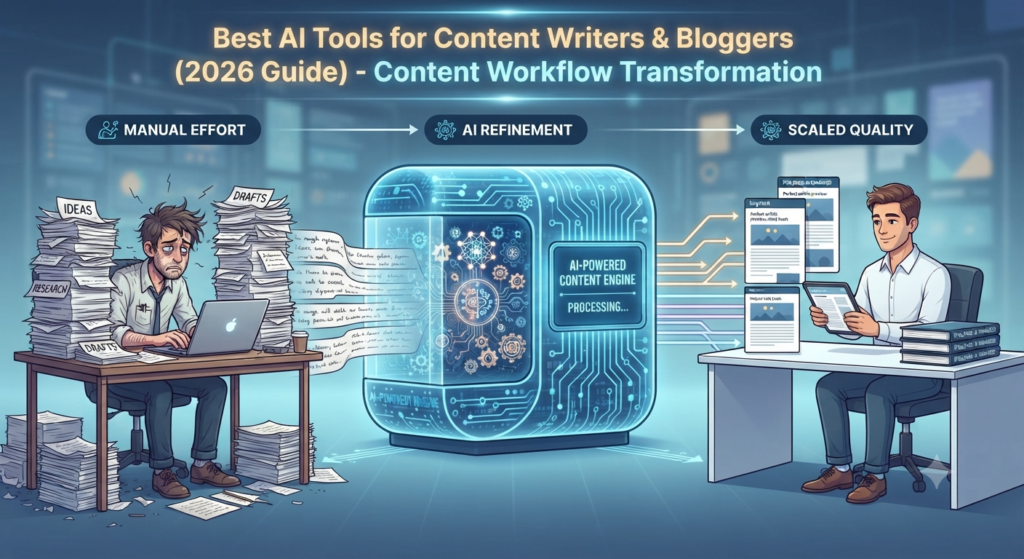
What your readers and search engines want and how AI can help you align your content strategy with your readers’ needs.
The 9 Best AI Tools for Content Writers & Bloggers in 2026
The 9 Best AI Tools for Content Writers & Bloggers in 2026 is a helpful guide for anyone seeking to enhance their blogging or content-writing abilities.
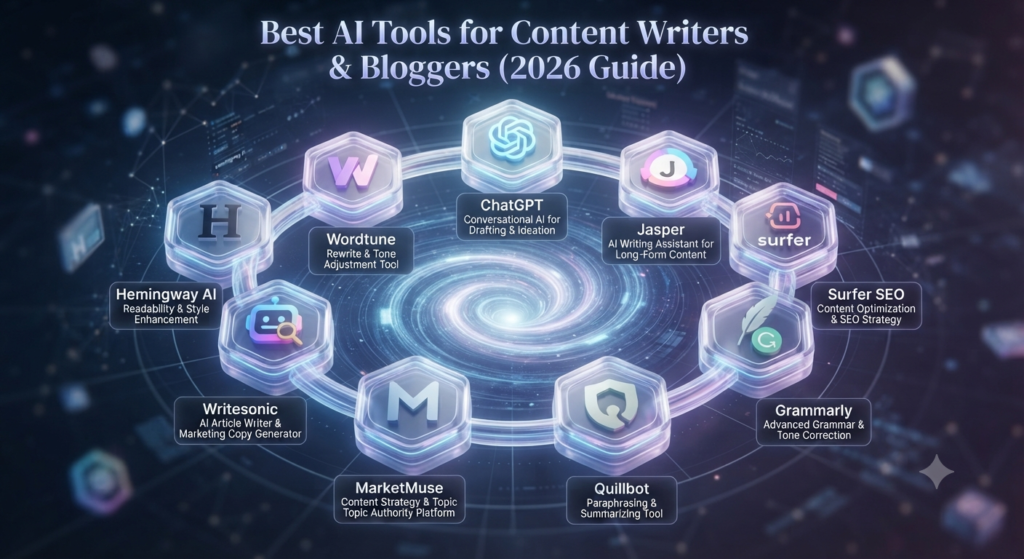
1. ChatGPT: The Ultimate Creative Partner
ChatGPT can serve as a creative partner for bloggers and content writers. It can help with brainstorming, outlining, rewriting, summarizing, creating FAQs, writing meta descriptions, and improving article flow.”. ChatGPT helps with brainstorming, outlining, rewriting, summarizing, creating FAQs, writing meta descriptions, and improving article flow. It’s also useful for generating ideas, adjusting your tone, and supporting in-depth research.
Best for: Conceptualizing ideas and angles.
2. Claude: The King of Natural Writing
Claude can produce natural, fluent writing and is well suited to long-form content. It can handle large amounts of information while maintaining a natural and conversational tone.
Best for: Long form, conversational writing.
3. Jasper: Best for Brand-Consistent Marketing
Jasper is well suited to brand-consistent marketing. Jasper is particularly useful if you’re running a business blog. It has “Brand Voice” that ensures uniformity of your content in each and every post.
Best for: Brand-aligned content with a consistent voice.
4. Surfer SEO: The Data-Driven Optimizer
Don’t second-guess Google. Surfer SEO analyzes pages that rank and provides you with a score to determine the specific ways to optimize your draft.
Best for: SEO optimization and SERP dominance.
5. Frase: Research & Brief Generation
Add as much data as possible. Frase is a boon for research. It brings together ranking search results and creates detailed content briefs in minutes.
Best for: Research and structural planning.
6. Grammarly – Your safety net!
Grammarly works to enhance clarity, tone and conciseness, so you can never be less professional.
Best for: Grammar, clarity, tone, punctuation, and readability improvement.
7. Perplexity: The Future of AI Search
Perplexity is the place to go for facts when you need them. It’s an Artificial Intelligence-powered research assistant that offers cited, current information.
Best for: Fact-checking and real time research.
8. Canva: An Easy-to-Use Visual Storytelling Tool
Canva Magic Design and Magic Write help bloggers create featured images, Pinterest pins, and social media graphics within minutes.
Best for: Scroll-stopping visuals.
9. Notion AI: Centralized Command Centre
Many bloggers use Notion AI to manage editorial calendars, store research, create outlines, and track publishing schedules.
Best for: Content management.
How to Maintain the Human Touch: The Secret Sauce for AI-Assisted Blogging
In the era of generative AI, it’s tempting to automate content creation. AI is a tool, not an author. As long as you use AI as a tool rather than a replacement for your own judgment and creativity, you can keep your content authentic.
To get the best of both worlds, here are some tips on how to leverage AI without losing the human touch:

1. Beyond the Prompt: Your Lived Experience is Your SEO Advantage.
AI can generate content based on patterns learned from existing information.
- Use Personal Anecdotes: Instead of the examples generated by AI, use stories from your own success or failure.
- Add Expert Opinion: Take a stance and give a nuanced opinion.
2. The Edit-First Workflow: From Draft to Voice
Never publish raw AI-generated text without reviewing and editing it first. Transform machine-generated drafts into a human-centered final product.
- The “Voice Injection” Pass: Read your draft, then rewrite parts that sound stiff or robotic.
- Structural Refinement: Make sure your post has a clear structure and uses transitions that match your writing style.
3. Trust, But Verify – Fact-Checking 101
Think of AI as your sometimes less-than-dependable junior assistant. Verify every claim. Check the context to make sure the information is accurate and appropriate for your audience.
- Verify Every Claim: Make sure all information, quotes, and technical details are accurate.
- Check the Context: Make sure the information is accurate, appropriate, and relevant to your audience.
FAQs

1. Will AI tools replace human content creators?
Answer: No. AI is designed to increase productivity, not replace creators. It excels at drafting, ideation, and repetitive tasks.
2. Does Google penalize AI-generated content in 2026?
Answer: Google doesn’t penalize content solely because it is AI-generated. Its focus is on helpful content that provides value and meets user intent.
3. How do I stop AI content from sounding generic?
Answer: Inject your brand voice by providing AI with style guides, tone examples and personal anecdotes. Always perform an “edit pass.”
4. Which AI tool is best for writing blog posts from scratch?
Answer: ChatGPT and Claude are among the best choices for creating complete blog drafts, while Surfer SEO helps optimize them for search engines.
5. Are specialized AI tools better than ChatGPT?
Answer: It depends on your workflow. Specialized tools offer integrated features that save time on tasks.
6. What is the difference between standard and agentic AI?
Answer: Standard AI generates text or images based on prompts. Agentic AI can take actions, such as updating a WordPress CMS or managing workflows.
7. How much should I budget for AI tools?
Answer: Budgets can vary depending on what you need. Many tools offer free versions with limits on how much you can use them. Professional tools for larger content teams can cost more depending on their features, usage limits, and integrations.
8. What is the best AI tool for SEO-focused blogging?
Answer: Surfer SEO is a strong choice for checking content in real time, finding keywords, and making sure your drafts are aligned with top search engine results.
9. Can AI help with turning one blog post into formats?
Answer: Yes, it can. Tools like Descript and Pictor can help turn a blog post into media clips, videos, and other content formats.
10. Are AI tools good enough for professional content?
Answer: Free tools are great for starting out or handling basic tasks. Professional content creators often pay for higher limits, better security and special features like working with teams and custom branding.
11. How do I make sure AI-generated articles are accurate?
Answer: Always check AI output as if it came from an intern. Verify facts, quotes, and technical claims to make sure they’re accurate. Also check that the context makes sense for your audience.
12. Will using AI tools for blogging hurt my SEO rankings?
Answer: Using AI tools does not automatically hurt SEO. Focus on creating helpful, original, high-quality content that meets your readers’ needs.
13. Which tool is best for a beginner on a budget?
Answer: Start with the free version of ChatGPT for writing and Grammarly for editing.
14. Can AI really sound like my brand?
Answer: It can get close. You need to guide it. Use tools like Jasper. Train it on your old posts to keep your style consistent.
15. What is the biggest mistake bloggers make with AI?
Answer: Relying too heavily on AI. Don’t let it do all the thinking for you. It’s meant to help, not replace you.
EEAT
After testing multiple AI writing tools while creating this AI learning series, I found that each tool has its own strength. ChatGPT is excellent for brainstorming, Surfer SEO improves optimization, while Grammarly provides the final polish before publishing.

Conclusion
The shift toward AI-assisted blogging is here to stay. By picking the right tools for your specific needs, you’ll find you have more time to focus on the big-picture strategy. Remember: the best AI tools are only as good as the writer wielding them. AI won’t replace great writers—but writers who learn to use AI effectively will have a significant advantage in productivity and content quality.
Call to Action (CTA)
We want to hear from you! How do you balance the speed of AI with the authenticity of your touch?
• What is your must-have tool that made AI-assisted writing easier?
• For beginners: What was the biggest hurdle you faced and how did you overcome it?
• For freelancers: Do you have a favourite workflow secret that keeps your content sounding like you?