Ever feel like tech is going at warp speed? You’re not alone. 2026 is here, and AI is no longer the stuff of science fiction, it has become an everyday digital assistant. It’s not just about creating a picture in a matter of seconds, it’s about aiding you on your daily chores, automating your workday, or even helping you to complete huge projects. Let’s explore what AI is, how it works, where you already use it every day, and why understanding it has become an important skill in 2026.
What is AI, Exactly?
In essence, Artificial Intelligence (AI) is a technology that enables computers to think, learn, and make decisions like humans. Instead of following fixed instructions, AI can learn from data. It can write articles, create images, answer questions, and even solve difficult problems within seconds.
How Does AI Work?
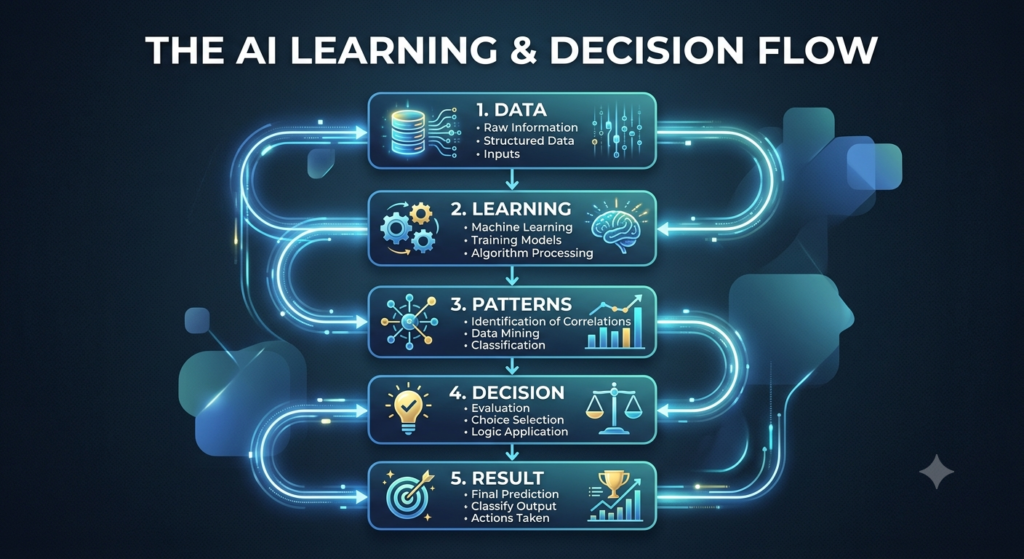
Now that you understand what AI is, let’s see how it actually works behind the scenes. It may sound like magic, but it’s actually pure data science. The way AI is used is by introducing a lot of data to a computer. This system identifies patterns, iteratively corrects itself and takes decisions similar to the human brain using smart mathematical formulas (algorithms). The more data it learns from, the smarter it becomes.
Examples of the use of AI in daily life
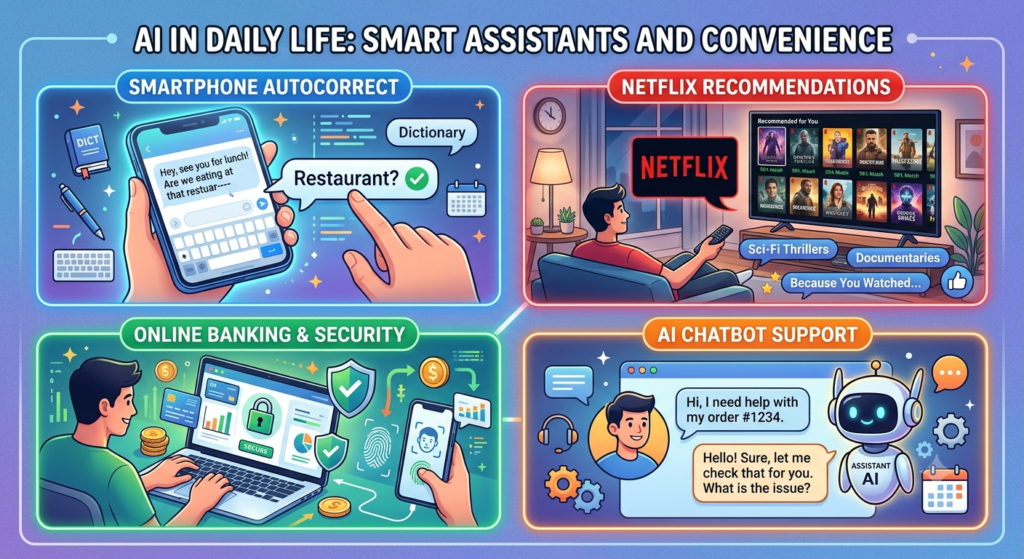
AI might be assisting you without you realizing it. This is where it has its place:
(a) Smart Keyboard Autocorrect: Not only does your smartphone correct typos and errors, it can anticipate what you’re about to type and even adjust to your language over time with its Smart Keyboard Autocorrect feature.
(b)Smart Fraud Detection: Banks rely on AI to detect fraud across millions of credit card transactions in real time. It helps you learn your normal spending patterns so that it alerts you and/or blocks unusual spending so you don’t lose money.
(c)Recommendation Systems:Netflix, Spotify, and other streaming platforms keep tabs on user preferences to create hyper-personalized movie queues and playlists
(d)Digital Assistants: Modern tools such as ChatGPT – with the power of Artificial Intelligence, chat naturally, respond to difficult questions and manage agendas.
Types of AI
AI comes in various forms. Generally, experts divide it into three different buckets:
(a) Narrow AI This is the AI that we can experience today. It’s very specific and designed to perform a specific function, such as facial recognition on your cellphone or recommending the next great song on Spotify.
(b) Generative AI is completely reshaping how we think about creativity. Whether it’s creating software, writing essays, or generating incredibly realistic photos from a description, Generative AI can produce entirely novel content.
(c) General AI (AGI) The next big breakthrough in technology is a machine that can think, reason and solve any problem just like well as a human being. It is widely being discussed in the tech community, but in the meantime, the much-anticipated AGI is still a science fiction film.
The Benefits of AI
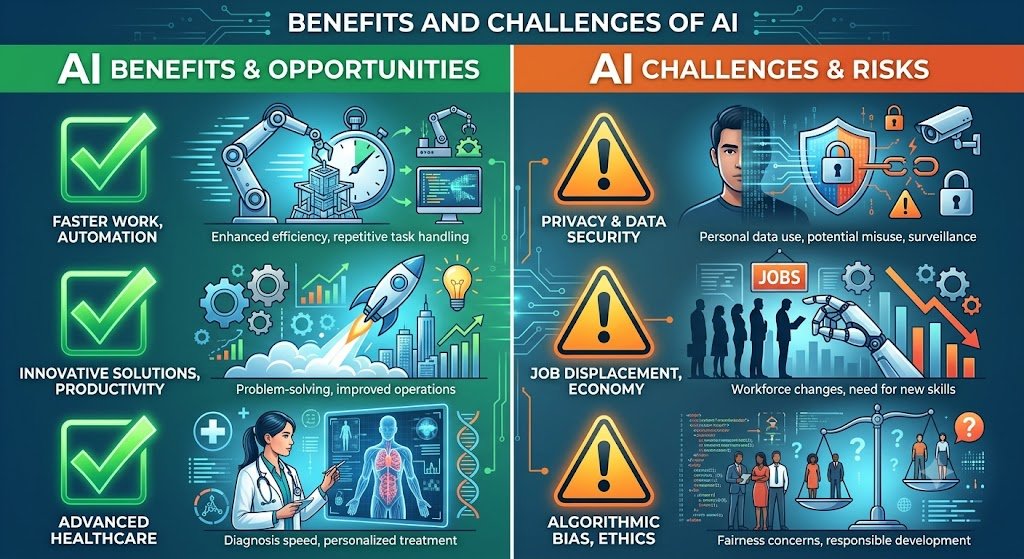
The rise of AI is the result of its ability to offer significant benefits and ease, that make life safer, smoother, and much more efficient.
(a) AI Eliminates tedious tasks: AI can handle mundane tasks such as sorting through spreadsheets or responding to simple emails, freeing up valuable time for you to focus on what matters.
(b) Fault Free Data: Humans are tired, distracted, AI is not. It can read heavy legal documents or process vast amounts of data and accurately calculate numbers without slipping up.
(c) Available 24/7: AI assistants are never tired. They can respond to customer service inquiries, teach students, or give simple medical advice even at 3 a.m.
(d) Solving Complex Problems: In healthcare, AI can quickly analyze medical images, detecting diseases at an early stage. It also assists scientists in analysing huge amounts of climate data to find practical solutions to go green in the real world.
Challenges of AI
The most critical challenges of AI. The Flip Side: Key Challenges of AI While AI is not without its challenges, like any technology, it has its own set of challenges to overcome and society must carefully navigate its developmental pains.
(a) Biased Data: AI Learns Human History. If the AI has been trained on some human bias, it will reflect that, possibly in the form of unfair hiring or lending decisions.
(b)Job Displacement: Automation is accelerating and jobs in customer support, data entry and basic writing are changing quickly, creating a huge demand for retraining.
(c)Privacy Issues: AI requires data, lots of it, to work its magic, and privacy pitfalls abound. This raises serious questions about the practices of the large tech firms in gathering, monitoring and protecting our personal data.
(d)The “Black Box” Problem: There are certain sophisticated AI models that are so complicated that even their creators are unable to explain why a particular conclusion has been reached.
Will AI Take Your Job?
The one thing that keeps us awake at night is the question of whether AI in the job market is here to stay. Yes, AI can take over mundane tasks, such as data entry, file sorting and simple coding, but it’s not a replacement for humans. Imagine it as a servant on par with any you could have in your hand. It takes the drudgery out of your job so you can concentrate on those strengths that are uniquely human: empathy, leadership, teamwork, and out-of-the-box creative thinking, for example. In the history of tech revolutions, there has never been a time when it didn’t alter the way we do our jobs. It’s not just taking jobs, it’s making new ones we never thought of.
How to Kickstart Your AI Learning Journey
Looking to break away from the “AI novelty” and enter the era of AI understanding? Here are some practical steps to help begin the process:
(a)Nail the Basics First: Pass the tough maths at the moment. Take free, easy-to-follow online courses, such as AI for Everyone by Andrew Ng on Coursera or YouTube.
(b)Pick a Language: Choose Python: Python: The undisputed King of AI programming. Easily read & filled with great coding libraries, such as Scikit-Learn. Let’s get practice: head to Kaggle. Get free datasets to work with, learn the ways great professionals code, and even create your own quick projects such as a house price prediction tool or image sorting application.
Pro Tip: Avoid “tutorial hell”! There is no better way to learn than watching hours of video. Do the little things, accept the bugs and learn through doing. All errors are data points that make you more intelligent!
FAQs
Q.1 Is AI difficult to learn?
Answer: No. Anyone can start with the basics using free online resources.
Q.2 Can AI replace humans?
Answer: AI can automate repetitive tasks, but human creativity, empathy, and judgment remain essential.
Q.3Which programming language is best for AI?
Answer: Python is the most popular language for beginners because of its simplicity and large collection of AI libraries.
Q.4 What is AI in simple terms?
Answer: An AI system can look at data, learn from its patterns, decide, and get a result—much like how you learn from experience over time.
Q.5 Is there a difference between “Machine Learning” and AI?
Answer: Yes. AI is the broad umbrella term for any technology that acts smart, while Machine Learning (ML) is a specific tool inside that umbrella where computers train themselves using data.
Q.6 How does AI affect my daily life without me realizing it?
Answer: You likely use it hourly through phone autocorrect, personalized Netflix recommendations, or banking fraud alerts. It constantly runs in the background to make your everyday tasks smoother.
Q.7 Do I need to be a math genius or know coding to learn AI?
Answer: Not at all! Building complex AI models requires math and coding, but simply learning to use and apply AI requires zero technical background. If you can use a smartphone and write a clear sentence, you can learn to leverage AI.
Q.8 How can I use AI right now to make money as a freelancer?
Answer: Use AI tools to speed up your workflow by brainstorming content outlines, proofreading code, or drafting client pitches. The trick is letting AI do the heavy lifting so you can complete and deliver client projects twice as fast.
Q.9 How can I kickstart my AI learning journey today for free?
Answer: Start by experimenting with free tools like ChatGPT or Claude to practice basic prompting. Then, explore free beginner courses on YouTube, Coursera, or edX to learn basic Python and data concepts.
Call-to-Action (CTA)
Have you used AI tools like ChatGPT or Gemini? Share your experience in the comments below. If you found this guide helpful, don’t forget to share it with your friends who want to start learning AI.