Ever feel like tech is going at warp speed? You’re not alone. 2026 is here, and AI is no longer just the stuff of science fiction. It has become part of our everyday digital lives. It’s not just about creating a picture in seconds. AI can also help with daily tasks, automate parts of your workday, and even assist you with large projects. Let’s explore what AI is, how it works, where you already use it every day, and why understanding it has become an important skill in 2026.
What is AI, Exactly?
In essence, Artificial Intelligence (AI) is a technology that enables computers to perform tasks that normally require human intelligence, such as recognizing patterns, understanding language, learning from data, and making decisions. Unlike traditional software that follows explicitly programmed instructions, many modern AI systems learn patterns from data. AI can write articles, create images, answer questions, and help solve complex problems.
How Does AI Work?
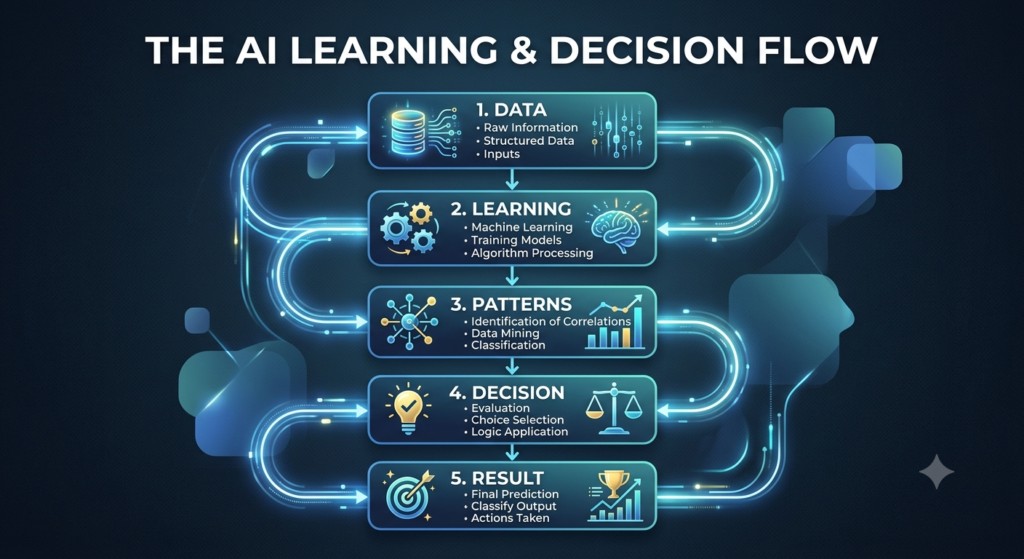
Now that you understand what AI is, let’s see how it actually works behind the scenes. It may sound like magic, but it’s actually pure data science. At a basic level, many AI systems are trained using large amounts of data. During training, an AI system identifies patterns in the data and adjusts its internal parameters to improve its results. It uses mathematical methods called algorithms and models to process information and generate outputs. In general, high-quality and relevant training data can help an AI system perform better, although more data does not always mean better results.
Examples of the use of AI in daily life
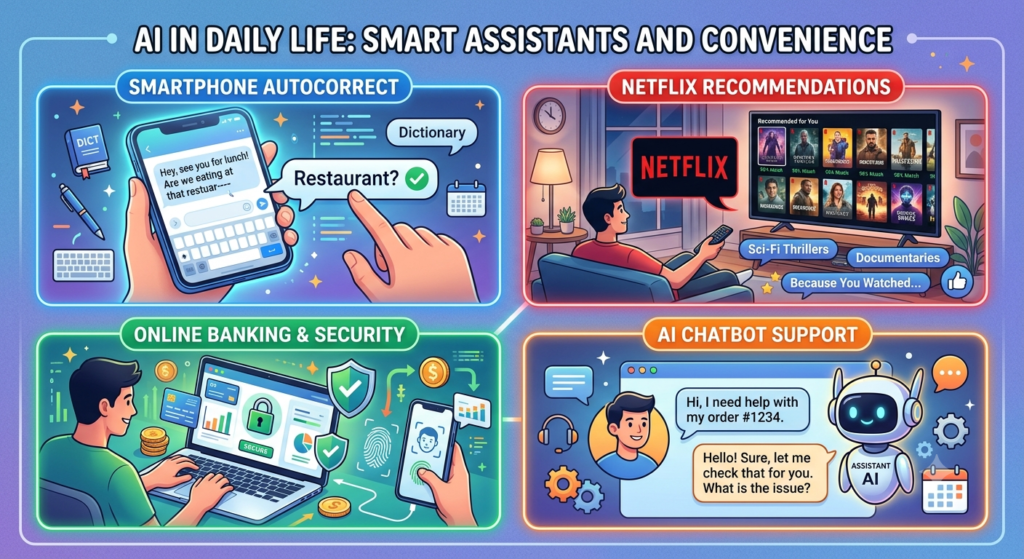
AI might be assisting you without you realizing it. This is where it has its place:
(a) Smart Keyboard Autocorrect: Your smartphone can correct typos, suggest words, predict what you may type next, and adapt to your writing habits over time.
(b)Smart Fraud Detection: Banks and payment companies use AI and other automated systems to detect unusual patterns across large numbers of transactions. By learning patterns associated with normal activity, these systems can flag or block suspicious transactions and help reduce fraud.
(c) Recommendation Systems: Netflix, Spotify, and other streaming platforms analyze user activity and preferences to recommend movies, shows, music, and playlists.
(d)Digital Assistants: Modern AI tools such as ChatGPT can understand natural-language questions, generate responses, and help users with tasks such as writing, brainstorming, and organizing information.
Types of AI
AI comes in various forms. Generally, experts divide it into three different buckets:
(a) Narrow AI, also called specialized AI, is designed to perform specific tasks. Examples include facial recognition, recommendation systems, and spam filters. Most AI applications we use today fall into this category.
(b) Generative AI is reshaping how we create and work with digital content. It can generate text, images, code, audio, and other content from instructions or prompts.
(c) Artificial General Intelligence (AGI) refers to a hypothetical form of AI that could perform a wide range of intellectual tasks at a level comparable to humans. AGI has not been achieved, and researchers continue to debate what capabilities would be required to reach it.
The Benefits of AI
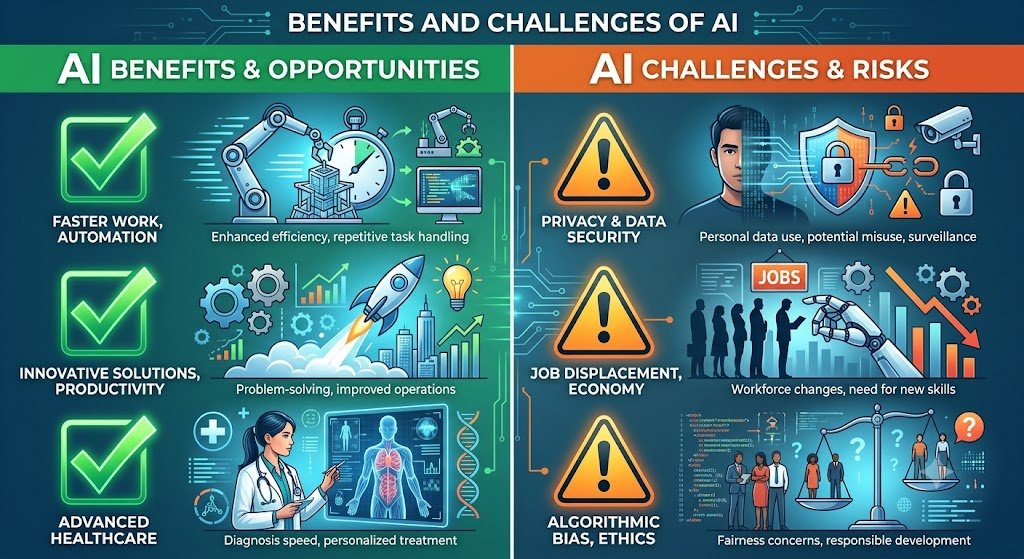
The rise of AI is the result of its ability to offer significant benefits and ease, that make life safer, smoother, and much more efficient.
(a) AI Eliminates tedious tasks: AI can handle mundane tasks such as sorting through spreadsheets or responding to simple emails, freeing up valuable time for you to focus on what matters.
(b) Fast Data Processing: AI can process and analyze large amounts of data quickly, helping people identify patterns, summarize information, and perform calculations. However, AI systems can still make mistakes, so important results should be checked.
(c) Available 24/7: AI assistants are never tired. AI-powered systems can respond to customer-service questions, support learning, or provide general information at any time. For important health decisions, people should consult a qualified healthcare professional.
(d) Solving Complex Problems: In healthcare, AI can quickly analyze medical images, detecting diseases at an early stage. It also assists scientists in analysing huge amounts of climate data to find practical solutions to go green in the real world.
Challenges of AI
The most critical challenges of AI. The Flip Side: Key Challenges of AI While AI is not without its challenges, like any technology, it has its own set of challenges to overcome and society must carefully navigate its developmental pains. Beginners should also learn to avoid common AI mistakes, especially blindly trusting AI-generated information.
(a) Biased Data: AI systems can reflect biases present in their training data or design. If those biases are not identified and addressed, they can contribute to unfair outcomes, such as in hiring or lending decisions.
(b)Job Displacement: Automation is accelerating and jobs in customer support, data entry and basic writing are changing quickly, creating a huge demand for retraining.
(c)Privacy Issues: AI requires data, lots of it, to work its magic, and privacy pitfalls abound. This raises serious questions about the practices of the large tech firms in gathering, monitoring and protecting our personal data.
(d)The “Black Box” Problem: There are certain sophisticated AI models that are so complicated that even their creators are unable to explain why a particular conclusion has been reached.
Will AI Take Your Job?
AI can automate some repetitive tasks, such as data entry, file sorting, and certain types of basic coding. However, its impact on jobs is more complicated than simply replacing humans. AI can change how people work, automate some tasks, and create demand for new skills and roles. Human abilities such as empathy, leadership, collaboration, judgment, and creative thinking remain valuable.
How to Kickstart Your AI Learning Journey
Once you understand the basics, learning to write better prompts can help you get more useful results from AI tools. Looking to break away from the “AI novelty” and enter the era of AI understanding? Here are some practical steps to help begin the process:
(a)Nail the Basics First: Don’t worry about advanced mathematics when you’re just starting. Begin with simple, beginner-friendly resources that explain AI concepts clearly. Take free, easy-to-follow online courses, such as AI for Everyone by Andrew Ng on Coursera or YouTube.
(b)Pick a Language: Choose Python: Python is one of the most widely used programming languages for AI and machine learning, and it has a large collection of useful libraries. It is relatively beginner-friendly and has popular libraries such as scikit-learn. Let’s get practice: head to Kaggle. Get free datasets to work with, learn the ways great professionals code, and even create your own quick projects such as a house price prediction tool or image sorting application.
Pro Tip: Avoid “tutorial hell”! TDon’t spend all your time watching tutorials. Practice by building small projects, making mistakes, and learning from them. Do the little things, accept the bugs and learn through doing. All errors are data points that make you more intelligent!
FAQs
Q.1 Is AI difficult to learn?
Answer: No. Anyone can start with the basics using free online resources.
Q.2 Can AI replace humans?
Answer: AI can automate repetitive tasks, but human creativity, empathy, and judgment remain essential.
Q.3Which programming language is best for AI?
Answer: Python is the most popular language for beginners because of its simplicity and large collection of AI libraries.
Q.4 What is AI in simple terms?
Answer: An AI system can process data, identify patterns, and use those patterns to generate an output or prediction.
Q.5 Is there a difference between “Machine Learning” and AI?
Answer: Yes. AI is the broader field of creating systems that can perform tasks associated with human intelligence. Machine Learning (ML) is a subset of AI in which systems learn patterns from data to make predictions or decisions.
Q.6 How does AI affect my daily life without me realizing it?
Answer: You likely use it hourly through phone autocorrect, personalized Netflix recommendations, or banking fraud alerts. It constantly runs in the background to make your everyday tasks smoother.
Q.7 Do I need to be a math genius or know coding to learn AI?
Answer: Not at all! Building complex AI models requires math and coding, but simply learning to use and apply AI requires zero technical background. If you can use a smartphone and write a clear sentence, you can learn to leverage AI.
Q.8 How can I use AI right now to make money as a freelancer?
Answer: Use AI tools to speed up your workflow by brainstorming content outlines, proofreading code, or drafting client pitches. Use AI tools to support your workflow by brainstorming content outlines, reviewing code, or drafting client pitches. Always review and improve the AI-generated work before delivering it to a client.
Q.9 How can I kickstart my AI learning journey today for free?
Answer: Start by experimenting with free tools like ChatGPT or Claude to practice basic prompting. Then, explore free beginner courses on YouTube, Coursera, or edX to learn basic Python and data concepts.
Call-to-Action (CTA)
Have you used AI tools like ChatGPT or Gemini? Share your experience in the comments below. If you found this guide helpful, don’t forget to share it with your friends who want to start learning AI.